
Inversion Line
Cape May Courthouse, New Jersey; Harriman State Park, New York; Lake Placid, New York

[First things:
Kendall Fortner Memorial Fund]
[Second thing: I’ll be writing over at The Trek for the next few months, and I hope for a while after that. You can keep up with some upcoming European hikes there.]
*
I quit my job the other day. (I am rather good, it turns out, at quitting jobs. But this is the last time, for a time.) An explanation: I saw the world and saw myself in it, and I realized I still had time.
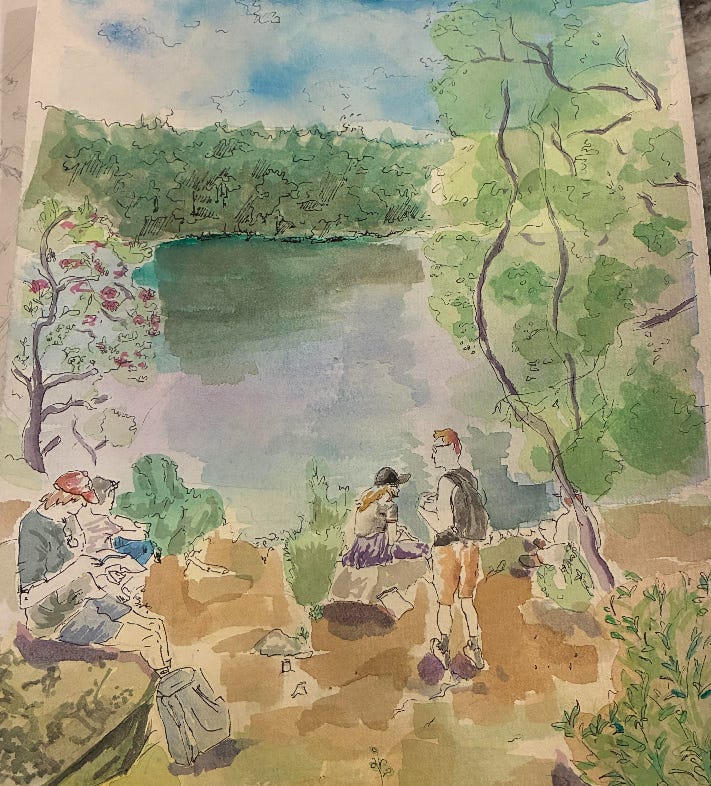
My students, by way of a good-luck gift, made me a notebook of sketches (“to watercolor!”) with notes on the back of each page. It took about two months to pass it around to everyone, per the student who organized everything, and, driving back from the bowling alley where we’d had our end-of-year robotics celebration, I had myself a cry. It was raining hard, which had something to do with it. But I have also quit jobs before. I received well-wishes then, and I did not feel deserving of them, and I do not feel deserving of these gifts now. Nevertheless.
Last year, my first year at this job, graduation was hot. We sweated, suffered. This year a cool, wet wind did its best to blow off my cap, but I held on. (I wear a hat now, sort of all the time. I do not know why.) The salutatorian and valedictorian spoke about change and time, and I was impressed. This is all life is, after all: change, time.
At some point this year Cape May and its surrounding communities became my home. When I think of home I think: this. I gave what little wisdom I’ve found. I coached a team. I bought a house. I did a few things to the best of my ability. I did my best.
At some point in the future Cape May will no longer be my home. This is probability. This is life, and all life is is change and time. Wherever I end up, though, I will remember and protect this time: the wind that day. The water, always. The drill press, which I never did feel safe with, not really. The ospreys, whose territories have shifted.
*
Breakneck Pond, located in Harriman State Park, is called what it’s called for reasons unknown. For almost four years I have been coming here and wondering why it’s called that—Breakneck—and lacking the service necessary to look it up. And then giving it up. The first few times were in autumn; I overturned rocks and disturbed salamanders. I learned the word senesce. I was in want of a home and I found one, and this home turned out to be a bunch of oddballs like me.
I sleep better with other people. I am not unique for this reason but I may well be rare. Nietzsche writes that people are stubborn in following the path they have chosen rather than their path as it is. I am trying, stubbornly, to follow the latter path.
On our second night in Harriman, Luke elbowed me and felt momentarily bad. But I was and am a mammal: I nestled; I nestle. We were three friends in a four-man tent. We called it, capitalized it, Boys Tent, chanted that, incanted it: Boys Tent, Boys Tent. We were close.
I have a tattoo on my chest that says, “I obey an average law.” That quote is about love, mostly, but also about averages, and as I age I am realizing this fact at the same pace as I am fulfilling its promise. I am converging upon the average. I am a mammal and I would like to belong.
The simple way to say all this is to say that when it is eight in the morning and then six at night in Harriman we all fall in line. Up in the dining hall there is food on or soon to be on the table and we all have found or are finding our table.
The first time I came to Harriman State Park and to Breakneck Pond I was on a detour. I had taken a fork and followed that offshoot here. The warning emblazoned at the edge of the dock told me the water was TWELVE FEET DEEP, which is a Front Bottoms song which means a lot to me, because a lot of songs mean a lot to me. But none of this is all that deep.
On the last morning I hiked to the shelter on Fingerboard Mountain. I had told Terry about my timeline for the Appalachian Trail and he had asked, concerned, “And you’re doing it alone?” But no one does it alone, not really: there is magic on the trail, a family you find. And besides: I told him he could hike alongside me for as long as he wished when I made it back up to New York. And he said he would like that.
The lesson I will always be learning is that each other is all we have. If there is any point to life it is this: life. This is the answer any worthwhile philosophy arrives at. This is Darwinism. Still. Something in me demands I prove myself. Still. And so I hiked the handful of miles to Fingerboard Mountain alone. I stopped for lunch at Lake Welch, watched small children flail into the shallows and old women wade after them, breathed deeply of the wafting barbecue, eavesdropped, smiled, walked on. I rode the shoulder of the rope of road dividing Lake Askoti and Lake Skannatati, both crowded with fishermen and swimmers, and wanted to stop, and didn’t. (“Askoti,” I have found out, means “this side”; “skannatati” means “the other side.”) I was hungry again by the time I got to the shelter. The trail offered a handful of early wild blueberries: enough to see me back, to the family I have found in New York. But not yet enough to stay.
*
The cool thing about having a sister who does cool things is sometimes you get to tag along to a cool place and do your own cool things.
Some cool things I did in Lake Placid:
Said, to too many horses, “Hey, horse!”
Spotted, from atop Haystack Mountain, the long jumps where the USA’s Olympic skiers practiced. The jumps, which towered about the fairgrounds, appeared diminutive: a life’s focus, out of place in the wilderness, a child’s plaything dropped into a hobbyist parent’s modge-podge Eden, squishable between forefinger and thumb.
Zoomed in on the fairgounds, texted the clip to my sister and mom. “I see you,” I said, in as creepy an inflection I could muster.
Hiked, in a forking out-and-back, from the Atmospheric Science Research Center to Mount Esther and then Whiteface Mountain (picture a Y, which the bottom the Center and the tips the peaks). Atop Mount Esther, a plaque in the ground commemorated Esther McComb, who completed the first recorded summit of the mountain. She was fifteen; the year was 1829. Consider the challenges of that, the wildness of that wilderness. “A rock in the ground,” another hiker, summiting a few minutes after me, called the plaque, underwhelmed. Esther McComb lived one hundred years, died as the First World War was kicking off. A blog post tells me there’s no evidence she ever actually existed. But I choose to believe.
Broke into a ski shack next to one of Whiteface’s lower lifts. (Walked in. The door was open.) Savored the uncanniness; I had been here before, seen things like this in a hundred post-apocalyptic fictions. From the scrawlings on the walls I reverse-engineered lives. TO ‘ELL IN A BUCKET, BUT AT LEAST I’M ENJOYING THE RIDE. Amen, buddy. To ‘ell in a bucket.
Read, in the novel I was reading, of the Purkinje effect, which describes the human eye’s tendency to become more sensitive to blue light in low-light conditions.
Navigated, patiently, the crowds at Whiteface’s peak. Strange, for so rugged a hike to end in a parking lot, for the stone tower visible for miles around to house a museum and scientific equipment made to monitor clouds, for skeptical early-twenty-somethings to hold the door for me. I took my time, resting my legs, wishing my grandfather were alive and here. He would have read everything. So I read as much as I could. It had taken a lot, it turned out, to create a highway to the peak, to cart all these stones up here. It had taken a lot to regrow these woods. I wished, briefly, that I had driven up here like everyone else, that I could share this with my mother, my sister. But the ache in my legs was a good ache, and my mother and sister were happier where they were. A weathered display mapped the Adirondacks’ forty-six high peaks for me. These mountains, another display told me, belonged to the Laurentian Shield—at least a billion years old, older than the Appalachian Mountains by an order of magnitude. These mountains, the mountains I hope to be hiking soon, were visible as tidy blue bumps to the east. The sky was paler there—a band of blue-white light I learned was called the inversion line. Warm, less-dense air trapped cooler air below, reversing the expected temperature gradient (simply: as we climb higher, temperatures typically go down). This phenomenon explained mirages: false coastlines, false ships. But this horizon was real, and beautiful, and true, and I sat with it, for a time.